|
People have always been drawn to flight, the development of which spans several centuries and took place in small increments. ____________________________________________________________________ |
||||
|
|
|
|
|
|
|
The sky lantern was the precursor to the hot air balloon. It was comprised of a small cage onto which paper has been glued with a flame suspended at the bottom opening. The heated the air inside the paper envelope created lift. It was invented in China around 250 AD and was initially used for military signaling. These days it's used in many countries as part of traditional festivities, for celebrations, and for play. ____________________________________________________________________ |
||||
|
|
|
|
|
|
|
In 1670, the Italian Jesuit Father Francesco Lana de Terzi described an aerial ship supported by four copper spheres from which the air had been evacuated. Being a mathematician and aeronautics pioneer his basic principle is sound but such a craft cannot be built because external atmospheric pressure would cause the spheres to collapse into the vacuum inside, unless the spheres’ thickness was such as to make them too heavy to be buoyant. Scientists hypothetically discussing such a craft today would call this a vacuum airship. ____________________________________________________________________ |
||||
|
|
|
|
|
|
|
The predecessor of the hot air balloon was envisaged around 1709 by the Brazilian born Portuguese Jesuit priest Bartolomeu de Gusmão. It was an aerial apparatus called Passarola. Terrified by the Inquisiton, at the recommendation of his friends he fled Portugal and soon after fell ill of fever and died in a hospital in Spain. Upon his death It transpired that he had left designs for a manned air ship. ____________________________________________________________________ |
||||
|
|
|
|
|
|
|
In April 1783 Joseph- ____________________________________________________________________ |
||||
|
|
|
|
|
|
|
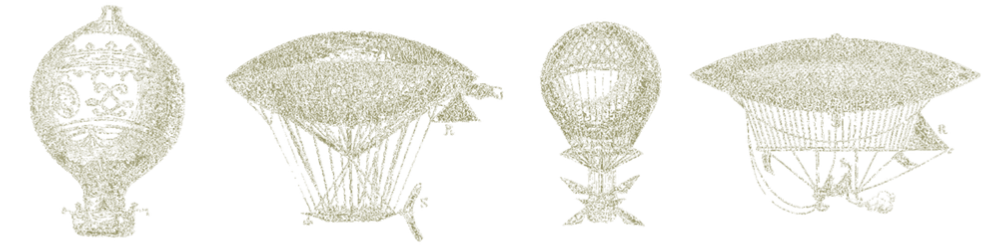
The Montgolfiere bothers gave a public demonstration of balloon flight at Annonay on 4 June 1783, where their new balloon rose to about 1,800 meters. This success resulted in a summons to the capital so that King Louis XVI could see the Montgolfier's invention for himself. ____________________________________________________________________ |
||||
|
|
|
|
|
|
|
In August 1783 Jacques Charles and the Robert brothers (Anne- ____________________________________________________________________ |
||||
|
|
|
|
|
|
|
As summonsed, the Montgolfiere Brothers’ third balloon, with a sheep, a rooster, and a duck as passengers, was launched at the Court of Versailles in September 1783. It climbed to over 500 meters before the astonished gaze of King Louis, Marie Antoinette, and their court. It landed about 3 kilometers away. ____________________________________________________________________ |
||||
|
|
|
|
|
|
|
Like the history of hot air balloons the history of airships began in France, the first mention of which was also in 1783. Not long after the Montgolfier Brothers September 1783 demonstration a French officer named Jean Baptiste Marie Meusnier designed a dirigible. It included a sail- ____________________________________________________________________ |
||||
|
|
|
|
|
|
|
The first balloon flight with humans on board was in a tethered balloon and took place in October 1783. On board were Marquis François d'Arlandes and Jean- ____________________________________________________________________ |
||||
|
|
|
|
|
|
|
In November of the same year the first untethered, hot air free flight with human passengers took place. With a smoky coal fed fire placed in an iron basket slung under the neck of the balloon it rose to almost fifteen meters. Outstandingly, the flame was controllable and replenishable by the passengers, Marquis François d'Arlandes and Jean- ____________________________________________________________________ |
||||
|
|
|
|
|
|
|
Only a few days later in December of 1783, amid vast crowds and excitement professor Jacques Charles and the Robert brothers launched the first, manned hydrogen balloon from the Jardin des Tuileries in Paris. Held on ropes, the balloon was led to its launching point by four of the leading noblemen in France. It is reported that 400,000 people witnessed the launch and that Benjamin Franklin was present. In the balloon Jacques Charles was accompanied by Nicolas- |
||||
|
|
|
|
|
|
|
Charles then decided to ascend again but because the balloon had lost some of its hydrogen they agreed he’d go alone. This time the balloon ascended rapidly to an altitude of about 3,000 meters where Charles was again able to see the sun. With aching pain in his ears he turned the valve to release hydrogen from the envelope and descended to land gently about 3 kilometers away at Tour du Lay. Charles never flew again. |
||||
|
|
|
|
|
|
|
During their flight Charles and Robert had carried a barometer and a thermometer to measure the pressure and the temperature of the air, making this not only the first manned hydrogen balloon flight, but also the first balloon flight to provide meteorological measurements of the atmosphere above the Earth's surface. ____________________________________________________________________ |
||||
|
|
|
|
|
|
|
After their successful hydrogen balloon flights in 1783, Anne- |
||||
|
|
|
|
|
|
|
In July of 1784 the brothers along with M. Collin- ____________________________________________________________________ |
||||
|
|
|
|
|
|
|
Following the invention of the modern parachute in 1783 by Sébastien Lenormand in France, in 1785 Jean- |
||||
|
|
|
|
|
|
|
In January 1785 Blanchard accomplished the next great aviation challenge which was to fly across the English Channel. Accompanying him was his American co pilot, John Jefferies. In the early days of ballooning, the English Channel was considered the first step to long distance ballooning so this was an important benchmark in ballooning history. ____________________________________________________________________ |
||||
|
|
|
|
|
|
|
The first aviation disaster occurred in May of 1785 when the crash of a balloon in Tullamore, Offaly County, Ireland, resulted in a fire that destroyed upwards of 100 houses causing serious damage to the town. Although it is not fully known what happened it is believed that during ascent the balloon basket snagged on a chimney which threw the basket, balloon, and flame out of upright alignment which set the balloon alight. The balloon fire caused it to descend as quickly as it arose. Unfortunately, the housing of the day was built with thatch, reeds, and rushes with the townspeople able to do little more than stay clear of the fire and wait for the flames to burn themselves out. |
||||
|
|
|
|
|
|
|
To this day, the town shield depicts a phoenix rising from the ashes. ____________________________________________________________________ |
||||
|
|
|
|
|
|
|
A month later the first fatal aviation disaster occurred when a hot air balloon crashed while attempting to cross the English Channel. The pilot was Jean- ____________________________________________________________________ |
||||
|
|
|
|
|
|
|
Jean- ____________________________________________________________________ |
||||
|
|
|
|
|
|
|
In 1852 a French engineer named Henri Giffard, built the first steerable airship. Filled with hydrogen gas it was driven by a 3 hp steam engine and it flew at 9 km/hr (6 mi/hr). Although Giffard's airship did fly it could not be completely controlled. Further, Giffard’s design was too slow to be considered an effective method of flight. However it gained a place in history as the first airship to fly with humans on board. ____________________________________________________________________ |
||||
|
|
|
|
|
|
|
In 1872 Paul Haenlein flew the first internal combustion motor- ____________________________________________________________________ |
||||
|
|
|
|
|
|
|
By now it had become a tradition that Champagne was shared each time a hot air balloon landed. Farmers believed that hot- ____________________________________________________________________ |
||||
|
|
|
|
|
|
|
Count Ferdinand von Zeppelin’s ideas for large airships were first expressed in a diary entry dated 25 March 1874. Inspired by a lecture given by Heinrich von Stephan on the subject of World Postal Services and Air Travel, he outlined the basic principle of his later craft: a large rigidly- ____________________________________________________________________ |
||||
|
|
|
|
|
|
|
In October 1883 the first airship powered by an electric motor was flown by brothers Albert- ____________________________________________________________________ |
||||
|
|
|
|
|
|
|
The first successfully navigated airship, La France, was built in 1884 by two more French nationals named Charles Renard and Arthur Constantin Krebs. Propelled by a 9 hp electrically driven airscrew, La France flew at 24 km/hr (15 mi/hr). The pilots enjoyed full control of La France which made it the first air vessel that could land at a desired destination. ____________________________________________________________________ |
||||
|
|
|
|
|
|
|
In 1887 the success of Charles Renard and Arthur Krebs' airship La France prompted Ferdinand von Zeppelin to send a letter to the King of Württemberg (previously a German state, now Baden- |
||||
|
|
|
|
|
|
|
After his resignation from the army in 1891 at age 52, Von Zeppelin devoted his full attention to airships. Von Zeppelin was among the first airship designers to realize, in practice, the advantages and functionality of greater size in lighter- ____________________________________________________________________ |
||||
|
|
|
|
|
|
|
The first to fly in an untethered airship powered by an internal combustion engine was Alberto Santos- |
||||
|
|
|
|
|
|
|
Because of their non- ____________________________________________________________________ |
||||
|
|
|
|
|
|
|
In December of 1903 Orville and Wilbur Wrights’ first aircraft made its maiden flight. It was named Flyer. It glided 37 meters in 12 seconds at the isolated fishing village of Kitty Hawk, North Carolina. The Wright brothers were not the first to build and fly experimental aircraft but they are the first to invent aircraft controls that made fixed wing flight possible. The Wrights decided that Kitty Hawk’s frequent winds and soft sandy surfaces were suitable for their glider experiments, which they conducted over a three- |
||||
|
|
|
|
|
|
|
In 1911 Clyde Cessna was the first person to learn how to control a powered airplane during flight. He had to take on this challenge without the help of anyone who themselves had previously flown. After twelve crashes, a few of which caused him serious injury, he was able to take off in a plane, spend some time maneuvering it around in the air, and then bring it in for a safe landing. Cessna’s flights took place in Kansas. |
||||
|
|
|
|
|
|
|
The Wright brothers' and Cessna’s efforts were the first steps towards modern day aeronautics. |
||||
|
|
|
|
|
|
|
The Wrights’ status as inventors of the airplane has historically been an issue of debate because of the fact that their flight, technically, was little more than a powered, controlled glide, and due to competing claims regarding other early aviators. ____________________________________________________________________ |
||||
|
|
|
|
|
|
|
The hot air balloon as we know it today was developed by Ed Yost during the 1950’s, with his first successful flight taking place in October of 1960. After Yost’s first successful flight hot air balloons became more popular. Gas balloons became the most common balloon type from the 1970’s. Hot air balloons are now primarily used for recreation. |
||||